
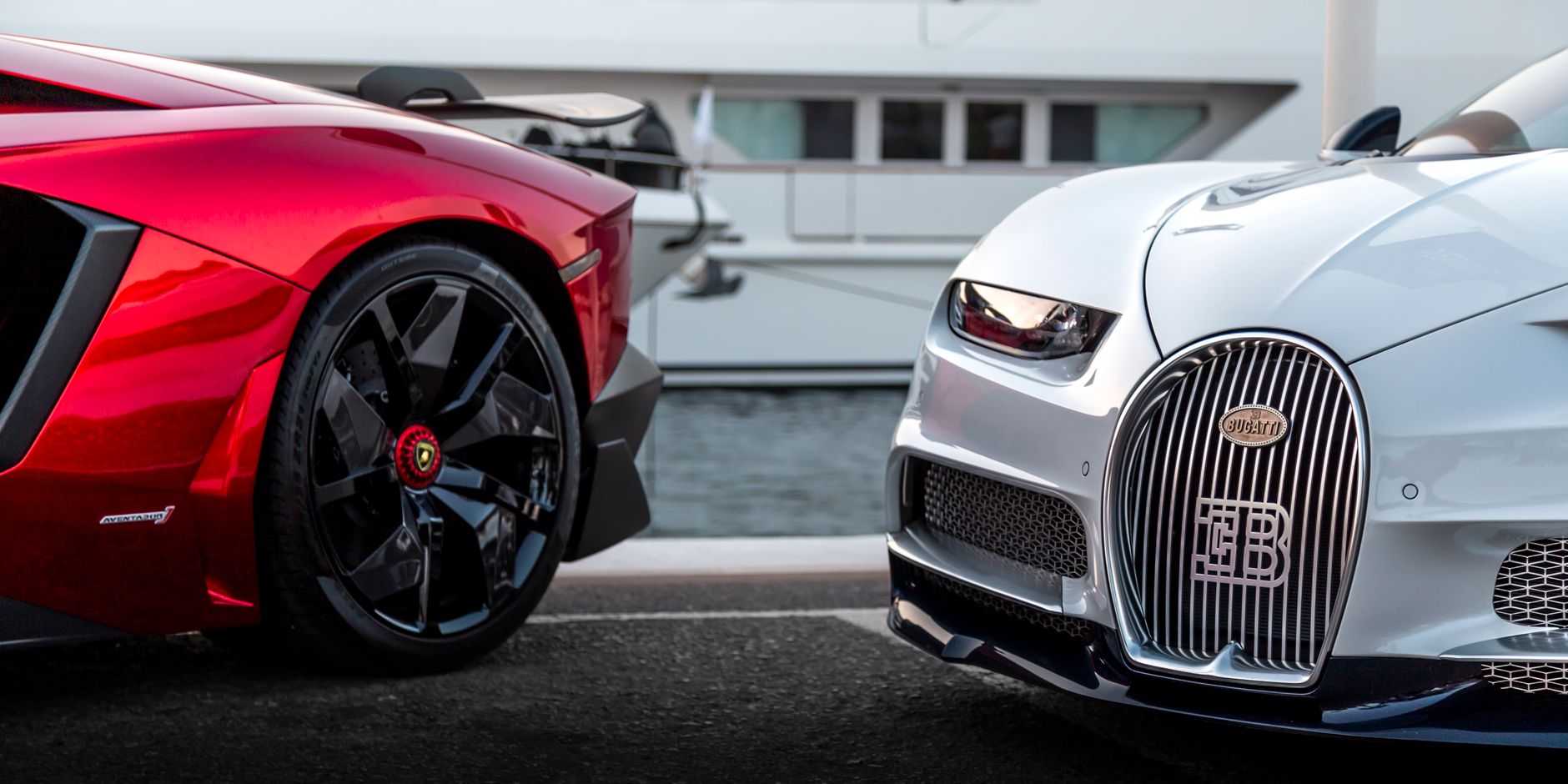
The last Bugatti Mistral has left the factory, marking the end of an era for the automaker’s signature 8.0-liter, quad-turbocharged W16 engine. The roadster, the 99th and final example, rolled off the production line in Molsheim, France, finished in a two-tone “Pearl” and “Sparkle” scheme with “The last of its kind” inscribed in several places on both the exterior and interior.
The W16’s two-decade run
Volkswagen Group began experimenting with large W-configuration engines in the 1990s. The 8.0-liter W16 that would eventually become Bugatti’s signature powerplant first appeared in 1999 in the Bentley Hunaudières concept. A year later, it reappeared in the Audi Rosemeyer concept, but it wouldn’t be until 2005, with the Bugatti Veyron 16.4, that we finally saw it in a production car, now with four turbochargers producing 987bhp and enabling a 253mph top speed.
The engine would grow in power over the years, first to 1,183bhp in the Veyron Super Sport, then to 1,479bhp in the Chiron, and finally to 1,578bhp in the Chiron Super Sport as well as a number of limited-run models including the EB110-inspired Centodieci, the track-only Bolide, and the Mistral, the car in which it makes its final appearance.
This isn’t just nostalgia for a particular engine layout. The W16 became a symbol of excess in an industry increasingly constrained by emissions regulations and shifting consumer priorities. Its retirement reflects a broader move away from raw displacement toward hybridized powerplants, even among hypercar manufacturers. Bugatti’s next act, the Tourbillon, replaces the W16 with a naturally aspirated 8.4-liter V16 paired with three electric motors, a configuration that would have seemed radical a decade ago but now feels like an inevitable compromise.
Related: More Kei Cars Coming to Britain as Suzuki Readies Honda Rival
What comes next—and what doesn’t
The Mistral’s production end doesn’t mean the W16 is gone for good. Bugatti’s Solitaire program, which creates one-off models from existing chassis and engines, could still produce new W16-powered cars. The program’s first two entries—the Brouillard and the Veyron-inspired F.K.P. Hommage—suggest the engine may live on in limited, bespoke form.
The Tourbillon, Bugatti’s next core model, abandons forced induction entirely. Its 8.4-liter V16, developed with Cosworth, produces 1,775 hp when combined with its electric motors.
The final Mistral will join a lineage of cars that defined an era of unapologetic performance. The Veyron, in particular, was a landmark vehicle, not just for its speed but for its ability to make hypercar ownership a reality for a small but dedicated group of enthusiasts. The Chiron refined the formula with improved aerodynamics and enhanced driving trends. The Mistral, as the last W16-powered Bugatti, represents the culmination of two decades of engineering evolution. But its departure also signals the end of a chapter where power was measured in liters and turbos, not kilowatts and battery packs.


