
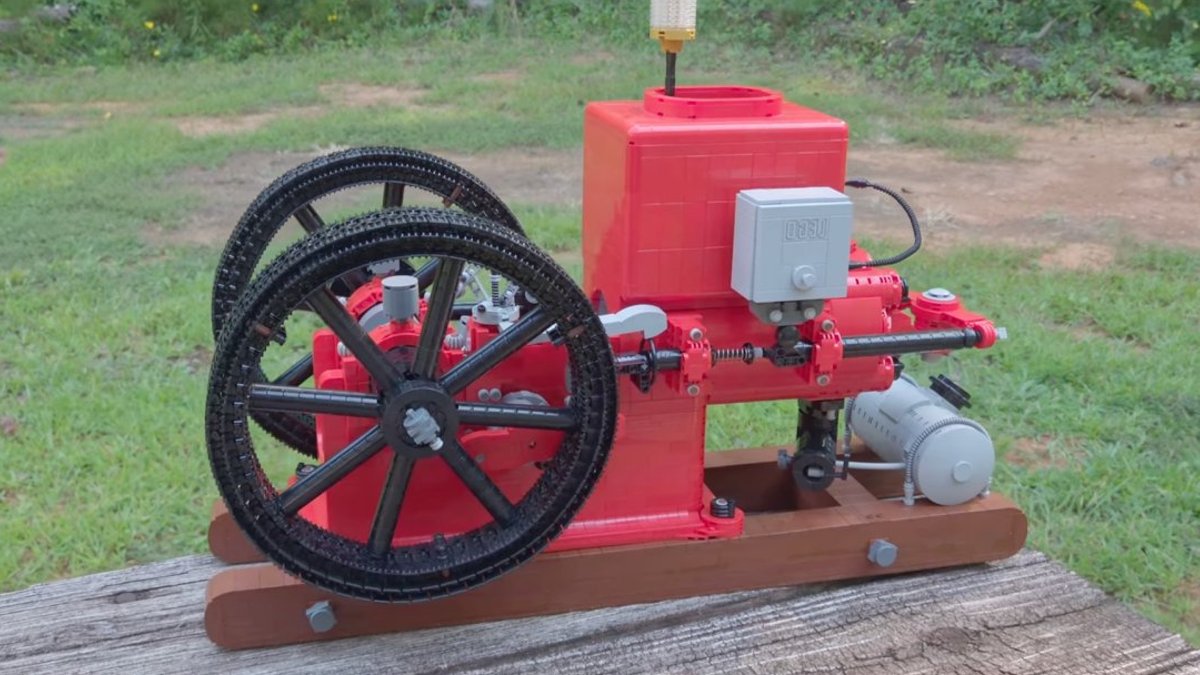
Lego pieces can be used to build a wide range of things, including working engines. Delton Adams, a YouTuber, built a working “hit-and-miss” engine using Lego, with vacuum power instead of combustion to get it to spin.
A hit-and-miss engine is an evolutionary dead end of internal combustion, and they have not been in common use since the 1930s. The name comes from the way these engines only get ignition while running at a certain speed, otherwise they cycle without ignition using a governor mechanism to hold the exhaust valve open.
Adams’ Lego hit-and-miss engine is a four-stroke model, but it uses a two-stroke cycle due to the vacuum operation. To make the engine more realistic, Adams used an inverted cam and rocker, with a spring to operate the valve against vacuum pressure, and a period-correct fly-ball mechanism operated by centrifugal force.
The engine‘s components, including the crankshaft, piston, and cylinder head, are replicated in plastic. The finished engine generates 0.12 watts of power, or approximately 1.5 “studpower,” a measure of power output for Lego engines.
While the power output may not be impressive, the faithful replica keeps the memory of real hit-and-miss engines alive. These engines were briefly popular as stationary power sources in the early 20th century, but they fell out of favor due to their limited power output.


