
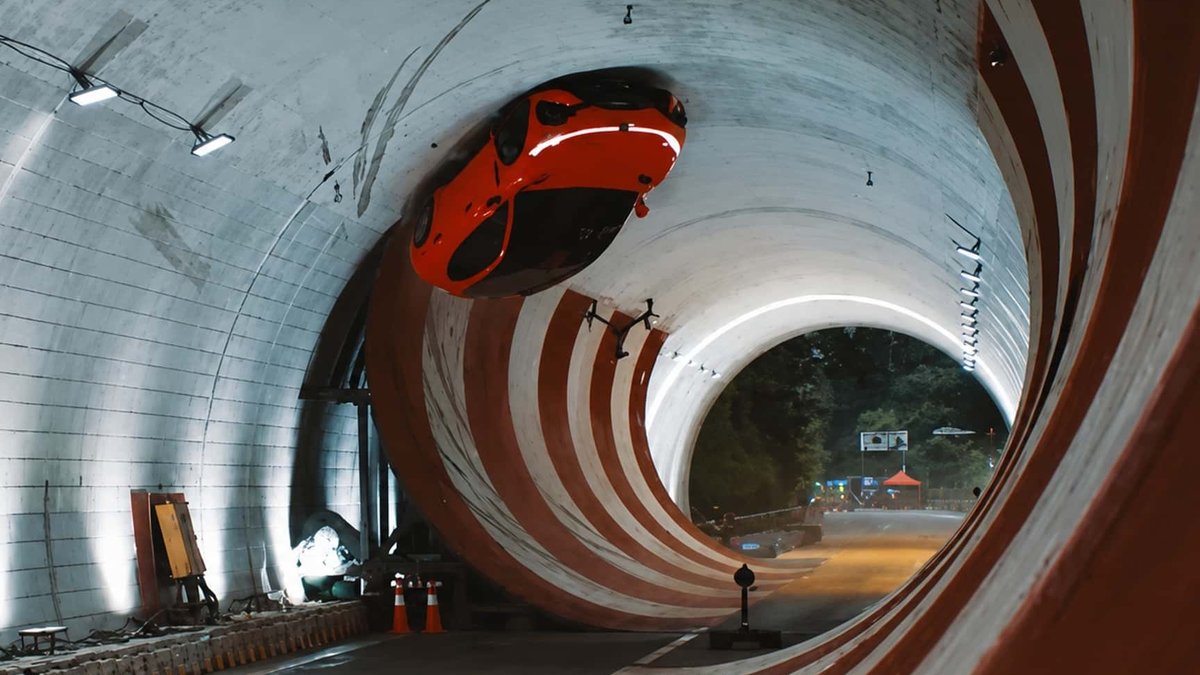
The Chinese automaker Dongfeng has recreated one of the most debated car ads of the past two decades—this time with its new electric SUV, the Voyah S, driving upside down in a tunnel. The stunt, executed in a controlled environment, serves as a technical demonstration and a marketing move in an industry where differentiation is increasingly difficult. Dongfeng’s decision to revisit the Mercedes-Benz controversy is a calculated move to capture attention in a market saturated with new models.
Sixteen years ago, Mercedes-Benz claimed its SLS AMG supercar looped inside a tunnel—with Michael Schumacher at the wheel. The ad became one of the most controversial of the 2000s. Dongfeng’s recreation of the stunt is framed as a direct response to that controversy. The state-owned company asserts that its version, filmed in a closed test tunnel in Wuhan, is entirely real, with no digital manipulation or hidden edits. A stock Voyah S electric SUV reportedly completed a full 360-degree loop, hitting a ramp at 81 mph with a precise 16-degree steering angle. The physics behind the maneuver rely on centrifugal force, which counteracts gravity and keeps the vehicle pressed against the tunnel surface. This phenomenon is often compared to the way clothes stick to the drum of a spinning washing machine, where the outward force generated by rotation overcomes the pull of gravity.
The execution of the stunt required meticulous planning. Engineers had to account for variables such as the tunnel’s curvature, the vehicle’s weight distribution, and the exact speed and angle of approach. The 16-degree steering angle was critical to ensuring the SUV maintained contact with the ceiling without veering off course. The 81 mph entry speed was calculated to generate sufficient centrifugal force—approximately 1G—to keep the vehicle stable. Video footage of the stunt shows the red SUV emerging unscathed, though the presence of tire marks on the ceiling suggests Dongfeng’s team did not achieve perfection on the first attempt. These marks indicate multiple runs, likely used to fine-tune the approach and ensure the vehicle’s trajectory was precise.
The choice of a closed test tunnel in Wuhan was strategic. Such facilities are designed for high-speed testing and are equipped with safety measures, including reinforced surfaces and emergency barriers. The tunnel’s controlled environment minimized external variables like wind or temperature fluctuations, which could have affected the stunt’s outcome. Additionally, the lack of public access ensured that the attempt could be repeated without risk to bystanders.
A Ferrari lookalike with Huawei tech
The Voyah S, which bears a striking resemblance to the Ferrari Purosangue, starts at $45,600 in China. Its design language has drawn comparisons to the Italian SUV. The pricing positions the Voyah S as a premium offering in China’s electric vehicle market, where competition is fierce.
The SUV’s powertrain is a key selling point. It packs an 800-volt, 98-kWh battery delivering up to 460 miles of range on the two-wheel-drive model, a figure derived from China’s CLTC standard. The dual-motor version, which produces 637 horsepower, accelerates from 0 to 62 mph in 4.5 seconds. The 800-volt architecture enables faster charging times, a critical factor for consumers who prioritize convenience. Under optimal conditions, the battery can be replenished from 10% to 80% in under 20 minutes.
Related: Tesla Roadster May Get Street Legal Version
Underneath, the Voyah S features a double-wishbone front suspension and a five-link aluminum rear setup, a configuration typically found in luxury performance vehicles. The suspension system is complemented by adaptive dampers and air springs, which adjust in real-time to road conditions. The use of aluminum in the rear suspension reduces unsprung weight, improving both responsiveness and efficiency.
Huawei’s involvement in the Voyah S extends beyond mere component supply. The tech giant provides a quad-lidar advanced driver-assistance system (ADAS) that integrates 33 sensors, including cameras, radar, and ultrasonic detectors. This system enables Level 2+ autonomous driving capabilities. The inclusion of four lidar units enhances the vehicle’s ability to detect and respond to obstacles in three dimensions. Inside, the cabin is dominated by dual 15.6-inch touchscreens and a 29-inch augmented reality heads-up display (AR HUD) that projects critical information onto the windshield.
The integration of Huawei’s technology reflects a broader trend in China’s automotive industry, where tech companies are playing an increasingly prominent role in vehicle development. Huawei’s HarmonyOS powers the Voyah S’s infotainment system, offering seamless connectivity with other smart devices.
Whether the stunt will move the needle in China’s crowded EV market remains unclear. The country sees dozens of new models debut every month, and automakers are under pressure to stand out. The Voyah S’s combination of performance, technology, and design may resonate with consumers, but the market’s rapid pace means that even innovative features can quickly become commonplace. Dongfeng’s decision to highlight the SUV’s real-world capabilities through a high-profile stunt could generate buzz, though it also invites scrutiny.
If the loop was indeed real, it wouldn’t be the first time physics defied expectations. The principles behind the stunt are well-documented, with centrifugal force being a fundamental concept in mechanics. However, executing such a maneuver with a production vehicle demonstrates a level of engineering confidence. For Dongfeng, the bigger question is whether the spectacle will translate into sales. The Voyah S is already available for order, with deliveries expected to begin later this year, but its long-term success will depend on factors beyond the stunt.
The broader context of China’s electric vehicle market adds another layer of complexity. Government incentives, infrastructure development, and shifting consumer preferences have created an environment where innovation is both rewarded and rapidly commoditized. Automakers must continuously push boundaries to maintain relevance. The Voyah S’s reception will offer insight into whether such tactics can sustain interest in an increasingly competitive setting.


