
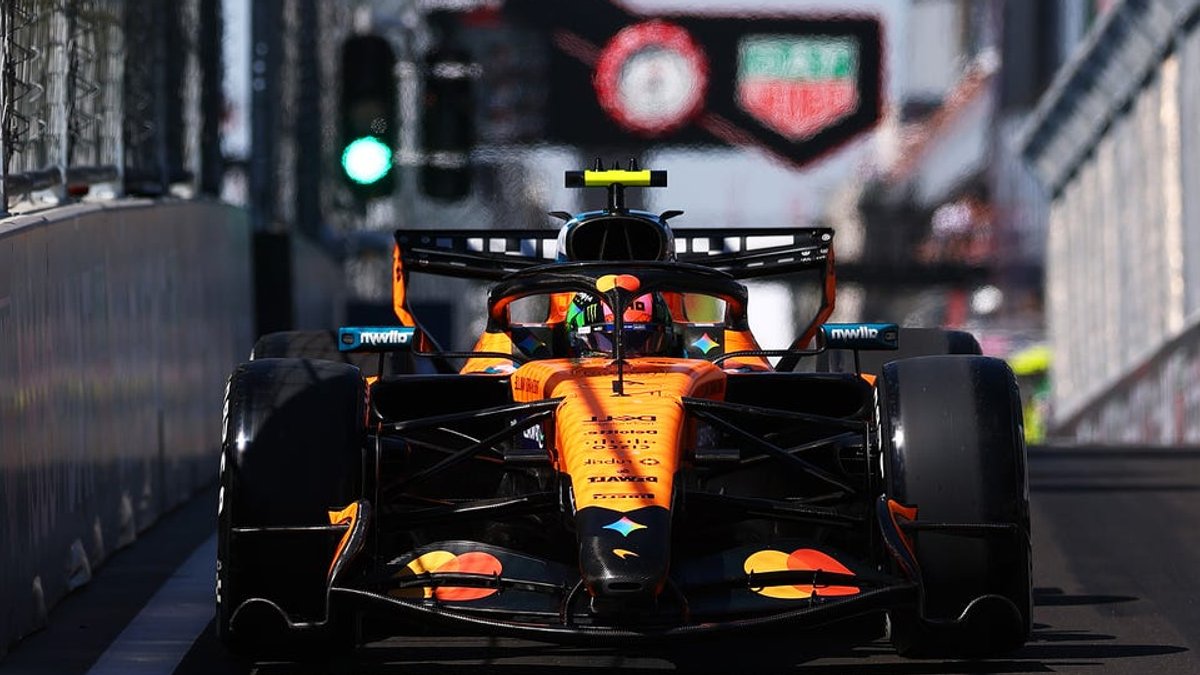
The newly renamed Madring Circuit hosted a Spanish Grand Prix that unfolded with remarkable calm, featuring no safety car deployments, no dramatic overtakes, and no chaotic moments. The race’s limited excitement stemmed from two defining incidents: Max Verstappen losing positions after a disputed chicane maneuver, and Lando Norris squandering a likely victory due to a poorly timed pit stop during a Virtual Safety Car period.
Challenges in overtaking had been anticipated before the race began. Pre-race simulations had already indicated the track would hinder passing attempts, and that prediction held true throughout the event. Despite these expectations, the early stages of the race still produced a few surprises. On the opening lap, Kimi Räikkönen—starting in second place—made two attempts to overtake pole-sitter Norris at the first chicane. Both efforts were abandoned, with Räikkönen admitting he had overestimated his chances.
“I did try, but obviously Lando is not going to let me pass by,” he said. “He did what he had to do. I cut the chicane twice. In the second chicane, I thought I could maybe make it, but I felt like it was too risky also for contact. So yeah, I decided to bail out…”
Verstappen, meanwhile, took evasive action at the first chicane to avoid collision with Lewis Hamilton, who had run off the track. The Dutch driver insisted his move was necessary to prevent damage to his car.
“I would have had damage at the start if I would have stayed on track,” he said. “It’s as simple as that. I just did my own thing in Turn 1, but Lewis went for a move on the first two and bottomed out on the curb, so he just jumped back onto the track, and that’s why I had to go off the road. If I would have stayed there, I would have definitely had contact. My race could have potentially been over in Turn 2.”
Red Bull’s team later directed Verstappen to allow Hamilton to rejoin ahead—a decision he initially questioned. By the time he complied, Hamilton had already fallen two positions behind, forcing Verstappen to let Räikkönen through first. The delay cost him valuable time, and though he later recovered to finish second, the incident raised doubts about whether he could have won without the setback.
Verstappen’s Disputed Chicane Maneuver Costs Red Bull
Laurent Mekies, Red Bull’s sporting director, later clarified that the team believed a penalty was unavoidable.
“No, I don’t think we could have won the race,” he said by Road Track. “A. because they were faster, B. because I think as much as it is a painful and difficult decision to make at that moment, I think the guys on pit wall did a very good job analyze the situation in as cold manner as they could, and took a fast and strong decision, and I think it would have been very, very difficult to think we could have avoided a penalty, as much as it is frustrating to be in that situation. But I think it would have been very difficult. And then, once you have a five- or 10-second penalty, it can affect your race in many different ways. But certainly doesn’t get you in a better position than P2.”
The race’s other key moment unfolded when Norris, leading comfortably, faced a critical decision during a Virtual Safety Car period triggered by Lance Stroll’s on-track stoppage. Running on worn tires, Norris was five seconds past the pit entry when the VSC was called. With no alternative, he pitted under green—a costly error.
Behind him, Räikkönen seized the opportunity, pitting under the VSC and emerging ahead. Norris’s slow tire change further worsened his position, dropping him behind Räikkönen, Verstappen, and even George Russell, who had also pitted under green. The only driver to avoid a pit stop was Charles Leclerc, who stayed out and finished fourth.
Read Also: Cops Catch VW Jetta With James Bond License Plate Hider
“I had to come in at the end of the lap because it was the only chance,” he said. “The fact that everyone’s kind of on colder tires and you’re still minimizing the pit loss. The medium tire was destroyed, and the hard tire was amazing.”
By the race’s end, Norris recovered to third place, but the outcome had already been decided. He attributed his loss to sheer bad luck, a factor that had never cost him a win before.
Norris also criticized the Virtual Safety Car system, pointing out that drivers arriving late to the pits during such periods receive no protection.
“We have spoken about it in the past several times,” he said. “About how it can be at least covered for one lap, or everyone has the opportunity to do the pit stops, or you just block the pit entry, and no one can box apart from if you have a puncture or something. So, I think there’s a few things you could do to make it simpler and fairer for everyone, but that’s a bigger discussion. This is not something I can just ask for. I think it’s something, as a group of drivers, I think we would all want, but there’s a lot more to it, depending on if it’s raining and there’s a VSC, and you’re on slicks, does it mean you can box or not? You know, so it’s a complicated subject.”
Virtual Safety Cars Create Unfair Pit Stop Chaos
The incident showed how easily a race can hinge on timing, with a single misstep capable of transforming a victory into a near-miss.
The Spanish Grand Prix at Madring also demonstrated how the track’s design, particularly its chicanes, would influence racing trends beyond the opening laps. While the first corner’s layout discouraged overtaking, the second chicane proved equally difficult to handle without risking contact. Räikkönen’s near-misses on the opening lap were not unique; other drivers struggled to find a clean line through the sequence.
Race control’s handling of the Virtual Safety Car further exposed inconsistencies in managing such periods. The VSC was activated by Stroll’s stoppage, but its brief duration, just under a lap, left Norris without protection when he reached the pits. Unlike full safety car periods, which allow all drivers to pit under cover, the VSC’s short window created disadvantages for those arriving late. Norris’s misfortune was compounded by Leclerc’s strategy: the Ferrari driver stayed out and finished ahead despite starting on harder tires. The incident reignited discussions among drivers about whether VSCs should include a mandatory one-lap buffer to ensure fair pit stop opportunities.
Tire Strategy Decides Races at Madring’s Challenging Track
The lack of overtaking at Madring was not solely due to the track’s layout but also the tire compounds in use. The hard tire, selected by Norris and others, proved unexpectedly durable, while the medium tire degraded rapidly under racing conditions. Norris’s comment about the medium being “destroyed” reflected a broader issue: drivers who pitted early on mediums struggled to match the pace of those on fresh hard tires later in the race. Pirelli later noted the hard tire’s longevity had exceeded expectations, though its grip in cooler conditions was slightly lower than anticipated. The disparity in tire performance added another layer of unpredictability, forcing drivers to weigh strategy against the risk of falling behind.
The final classification saw Räikkönen claim his first win since the 2021 Turkish Grand Prix, marking a significant milestone for Alfa Romeo. Räikkönen’s victory came after a season of inconsistent form, and his ability to exploit Norris’s error demonstrated the team’s resilience. Alfa Romeo had entered the year with modest expectations, but the win at Madring suggested the car’s strengths, particularly in tire management and reliability, could deliver results when strategy outweighed outright speed. The team’s celebration was tempered by the knowledge that the victory had come at Norris’s expense, a reminder of how fortunes can shift abruptly in Formula 1.


