
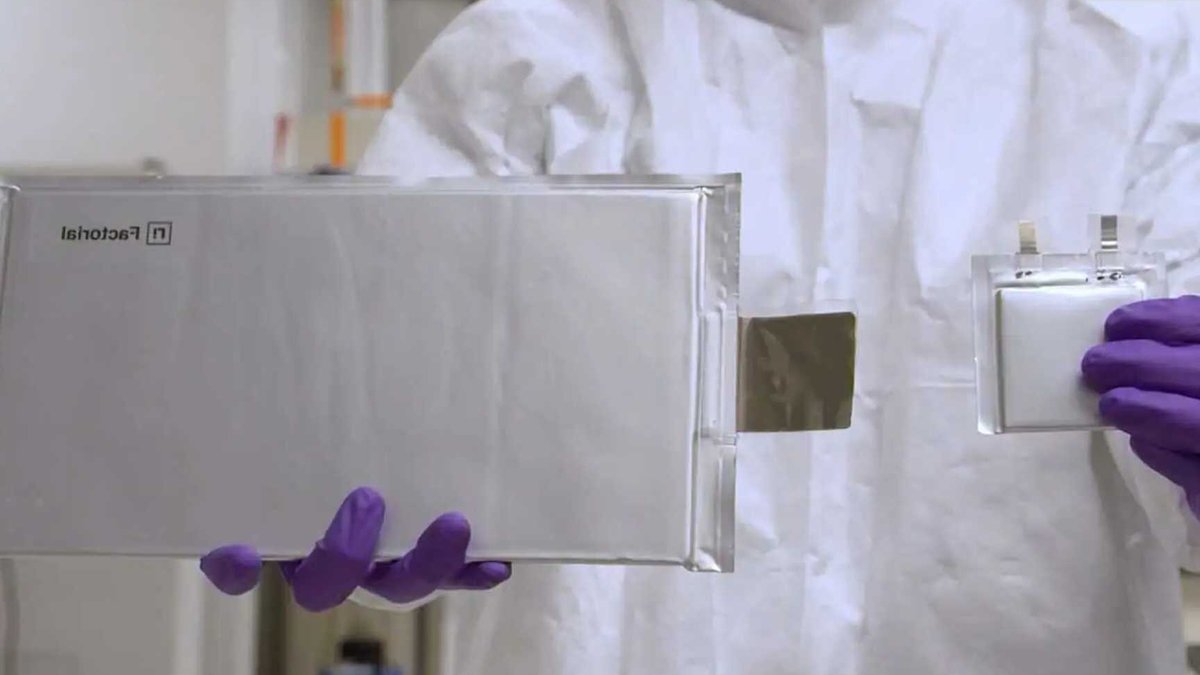
Factorial Energy, a Massachusetts‑based battery startup, has signed a memorandum of understanding with South Korean battery maker SK On to examine whether the latter’s existing lithium‑ion production lines can be adapted for large‑scale manufacturing of solid‑state cells.
Partnership aims to bridge lab results and factory floors
The startup has been developing solid‑ and semi‑solid‑state battery technology for several years and already works with automakers such as Mercedes‑Benz, Stellantis and Hyundai on prototype testing. Earlier this year, a Mercedes‑EQ S equipped with the company’s semi‑solid‑state battery logged a 749‑mile drive on a single charge, still showing about 84 miles of range when the test concluded.
Stellantis has also placed the battery in a prototype Dodge Charger Daytona as part of its on‑road evaluation program. Those field trials demonstrate that the chemistry can deliver the promised energy density and safety benefits, but scaling the process remains a major obstacle.
“A battery breakthrough only matters if it can be manufactured at scale,” said Siyu Huang, CEO of Factorial Energy, in a statement. “SK On’s manufacturing footprint spans some of the world’s most advanced battery facilities, and their expertise will be essential in shaping how solid‑state battery technology integrates into global production ecosystems.”
SK On supplies batteries to Hyundai, Kia, Ford, Volkswagen and Ferrari, and operates roughly 200 gigawatt‑hours of annual capacity worldwide, with about half of that installed in the United States. Their extensive network could provide the tooling, quality‑control systems and volume needed to move solid‑state designs from pilot batches to mass‑production runs.
Related: BYD challenges Toyota with new mini car
Industry context and the road ahead
Solid‑state batteries replace the flammable liquid electrolyte found in conventional lithium‑ion cells with a solid material, a change that can improve safety and enable faster charging. However, manufacturing these cells without defects has proved difficult, limiting their commercial availability.
SK On, which recently scaled back U.S. operations after the removal of federal EV incentives, is also shifting focus toward stationary energy storage. The company’s recent termination of a joint venture with Ford reflects that strategic pivot. Nonetheless, its existing production capacity remains a valuable asset for any effort to bring new battery chemistries to market.
The agreement is non‑binding, meaning either side can withdraw if the collaboration does not yield tangible progress. The startup has pursued similar informal arrangements with LG Chem and South Korean materials firms Philenergy and Posco Future M, indicating a broader strategy of leveraging established manufacturers to accelerate development.
From a broader perspective, the ability to retrofit current lithium‑ion lines for solid‑state production could lower entry barriers for automakers seeking higher‑performance packs without waiting for entirely new factories. If successful, this approach might shorten the timeline for solid‑state batteries to appear in consumer vehicles, especially as manufacturers scramble to meet stricter efficiency standards.
While the memorandum does not commit either party to specific investment levels, it outlines a joint technical review of how SK On’s equipment could accommodate Factorial’s cell architecture. The outcome of that review will determine whether pilot runs can transition to larger batches, and whether the solid‑state design can meet the reliability metrics required for commercial deployment.
Related: Chinese PHEVs Tested Over 700km in Australia
Analysts note that the partnership reflects a growing trend of startups aligning with established battery producers to solve scale‑up challenges. The collaboration could also provide SK On with a pathway to re‑enter the EV market in the United States, leveraging its existing capacity while addressing demand for next‑generation energy storage.
Both companies have indicated that the next steps will involve detailed engineering assessments and potential small‑scale production trials. If those trials demonstrate acceptable yields, the parties may consider deeper integration, though any such move would still be subject to market conditions and regulatory environments.
Factorial’s CEO emphasized that the ultimate test will be whether the technology can be produced consistently at volume. “Manufacturability is the litmus test for any breakthrough,” she said, adding that SK On’s experience will be important in evaluating that metric.
For now, the agreement remains a statement of intent, with concrete results likely to emerge later in the year as both firms conduct feasibility studies. The automotive industry will be watching closely, as the promise of solid‑state batteries continues to drive significant research investment worldwide.


