
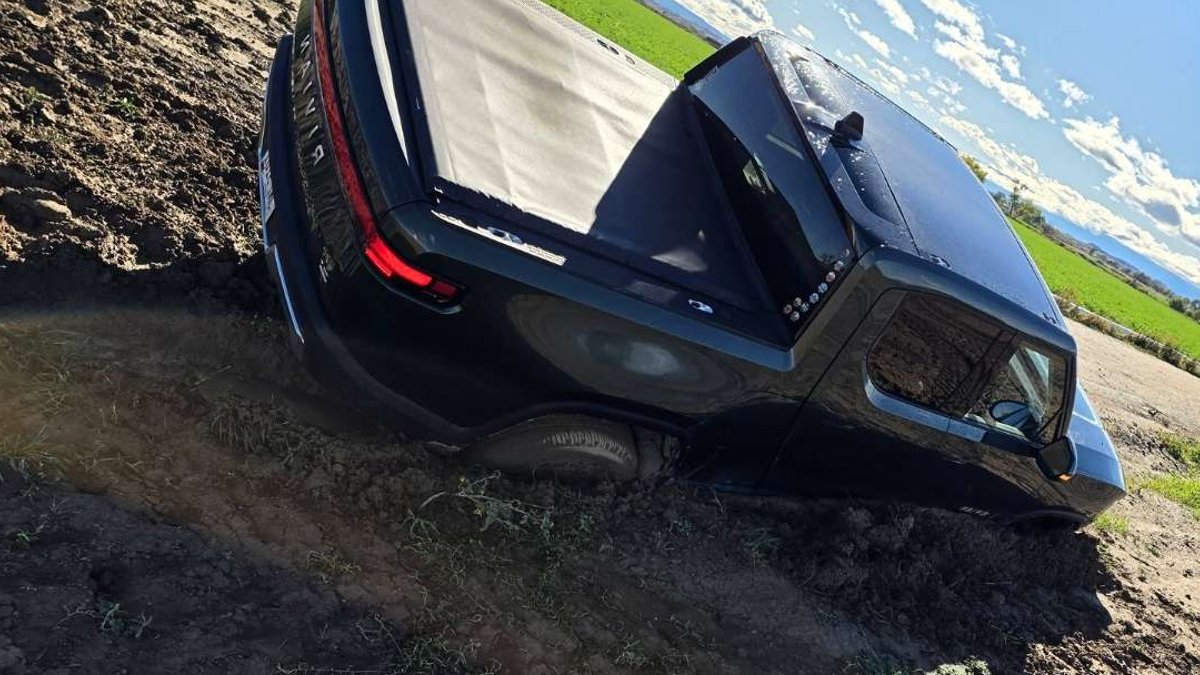
In Nevada, a Rivian R1T became stuck in approximately 2.5 feet of clay, prompting a fire truck to assist, which itself got stuck for four hours. After being pulled out by a tow truck, the R1T drove 1,000 miles home with nothing worse than scratched rims. This incident showcases the durability of the Rivian R1T, as well as its limitations in off-road performance on wet clay, where traction is lost regardless of drive mode or ride height. Carlos Guzman, the R1T’s owner, shared his experience and photos in a private Facebook group, describing how the truck immediately lost grip upon encountering the wet ground, and highlighting the challenges of recovering a vehicle stuck in such conditions.
How Did the Rivian R1T Get Stuck in Mud?
Rare rain in an area of Nevada that rarely sees precipitation turned the terrain into a field of clay. “Immediately went sliding sideways!” Guzman wrote, with photos showing the R1T buried past its tires on one side, tilted toward a field with deep ruts carved behind it. The situation became urgent when Guzman called the fire department, citing a baby in the car and doors that couldn’t be opened due to the mud’s height.
The fire department’s arrival did not resolve the issue. “Their huge truck also got stuck lol,” Guzman wrote, adding that it took responders four hours to free their vehicle. The next day, Guzman shared a photo of the ruts left behind, a stark reminder that wet clay can immobilize even large, powerful vehicles. Despite the ordeal, the R1T emerged with minimal damage after the tow truck’s intervention.
The Fire Truck That Tried to Help
Guzman’s account details the fire truck’s struggle. After four hours of effort, the fire department managed to extricate their own vehicle, leaving the R1T still stranded. A tow truck operator then provided a single, effective pull that freed the electric truck. “These things are tanks!” he wrote.
Other Rivian R1T owners have reported similar durability. One driver praised the truck’s performance after 20,000 miles, citing consistent power at high altitudes. Another owner, after 50,000 miles and 15 road trips, claimed the R1T outperformed a manual Toyota Tacoma. However, not all reports are flawless: one owner experienced a collapsed front air suspension at 60,000 miles, just out of warranty, resulting in a $7,500 repair.
The R1T’s off-road capabilities are limited by factors like weight and tire choice. Guzman tried every drive mode and raised the suspension to its highest setting, yet the mud’s consistency overpowered the truck’s design. “Weight is the enemy of these things offroad,” another owner noted, adding that even factory tires can struggle in slippery conditions. Guzman himself had never encountered traction issues before, suggesting the clay’s properties—not the truck—were the primary obstacle.
Off-Road Limitations in Wet Clay
The R1T’s design struggles with specific terrains like wet clay. Raising the suspension increases ground clearance but does not improve traction. When tires become packed with sticky mud, they lose grip regardless of drive modes. This limitation is not unique to the R1T but affects most vehicles in such conditions.
Weight exacerbates the problem. Heavy electric trucks sink faster in soft ground compared to lighter vehicles. Factory all-season tires, while adequate for some off-road use, may not perform optimally in deep mud. Owners suggest all-terrain tires with deeper tread patterns for better performance in slippery conditions.
Recovery Steps and Post-Stuck Checks
If an EV truck gets stuck, safety should be the priority. Spinning tires worsens the situation by digging deeper ruts. The source advises calling professional recovery services and using only manufacturer-approved recovery points to avoid damage. Never tow an EV with its wheels on the ground to prevent motor strain.
After freeing the vehicle, a thorough inspection is essential. Check underbody, wheel wells, and suspension for embedded mud or debris. Scratched rims or damaged components may require cleaning or repair. Clean cameras and sensors so driver assist features work properly. Rivian’s operator guide emphasizes using a recovery damper during winching to prevent sudden strain.
Wet clay’s consistency proved the primary obstacle in Guzman’s case, not the R1T’s engineering. The incident shows that even durable vehicles have terrain-specific limits. Owners recommend scouting unfamiliar terrain on foot before driving through it.


