
Reaction times in Tesla’s Full Self-Driving system vary significantly depending on whether the vehicle uses the latest hardware or older components. A recent test compared the newest software against previous versions to see how much quicker the system has become.
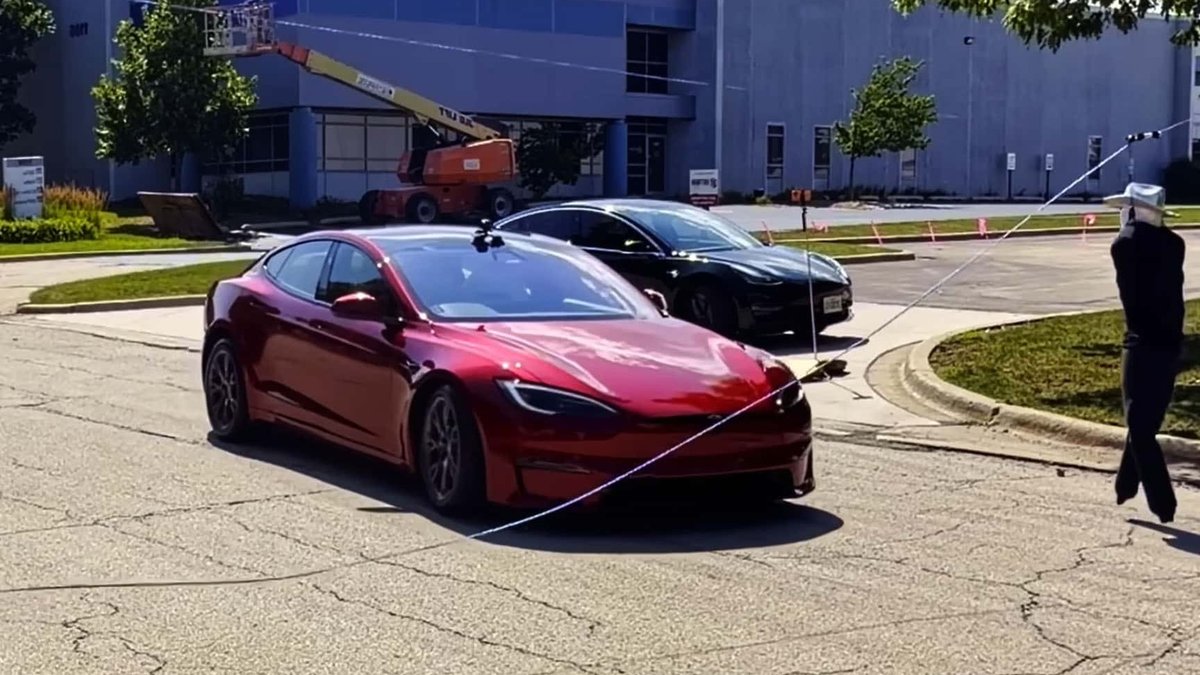
Reaction speed in automatic emergency braking depends on both the car’s physical hardware and its software stack. YouTuber TechGeek Tesla set out to measure how quickly Tesla vehicles react when simulating a pedestrian crossing the road. The test placed three different cars on the same route at the same speed to ensure consistency.
Two vehicles were equipped with the older Hardware 3 computer, while the third used the currently deployed Hardware 4. One HW3 car ran on Full Self-Driving version v12.6.4, another on v14 Lite, and the HW4 car used the full-fledged FSD v14.3.4. The YouTuber built a pulley system across the road to hoist a human-looking dummy into the path of the vehicles traveling at 23 MPH, measuring the speed of the car’s reaction to the fraction of a second.
The results show a clear advantage for the newer systems. The data below compares the reaction times across the different hardware and software combinations.
| Hardware | Software | Reaction Time (Seconds) | Delta From Baseline | Delta From v14 Lite |
|---|---|---|---|---|
| HW3 | 12.6.4 | 1.065 | Baseline | 57.8% Slower |
| HW3 | v14 Lite | 0.675 | 36.6% Faster | Baseline |
| HW4 | 14.3.4 | 0.450 | 57.8% Faster | 30.7% Faster |
The test revealed that software updates can provide a significant boost even on older hardware. The car running v14 Lite on HW3 reacted 36.6% faster than the same car running the older v12.6.4 software. This suggests that Tesla’s newer inference models allow the computer to process visual data more quickly, resulting in quicker braking decisions.
Meanwhile, the HW4 car with the latest software and hardware combination proved the fastest, reacting in just 0.450 seconds. This setup outperformed the older HW3 with v12.6.4 by 57.8%. The findings indicate that a mix of hardware and software is needed for the best safety and performance.
For drivers relying on these systems, the distinction between hardware generations becomes clear. Even a modest software update on an older chip can shave nearly half a second off reaction time, which is a significant margin in emergency situations. This highlights the tangible benefits of Tesla’s ongoing investment in computational power for its vehicles.
Tesla’s plan to double the memory in new HW4 units and develop more powerful AI5 chips suggests the company will continue to prioritize increasing the amount of compute available in its cars. The automaker has stated that more intensive inference models require this power to function safely.
Owners of older models often look for ways to improve their vehicle’s capabilities. For instance, [a recent offer in California allows residents to receive financial support for purchasing an electric vehicle](https://automotiveinfo.my.id/california-ev-rebate.html) that can be applied to newer models.


