
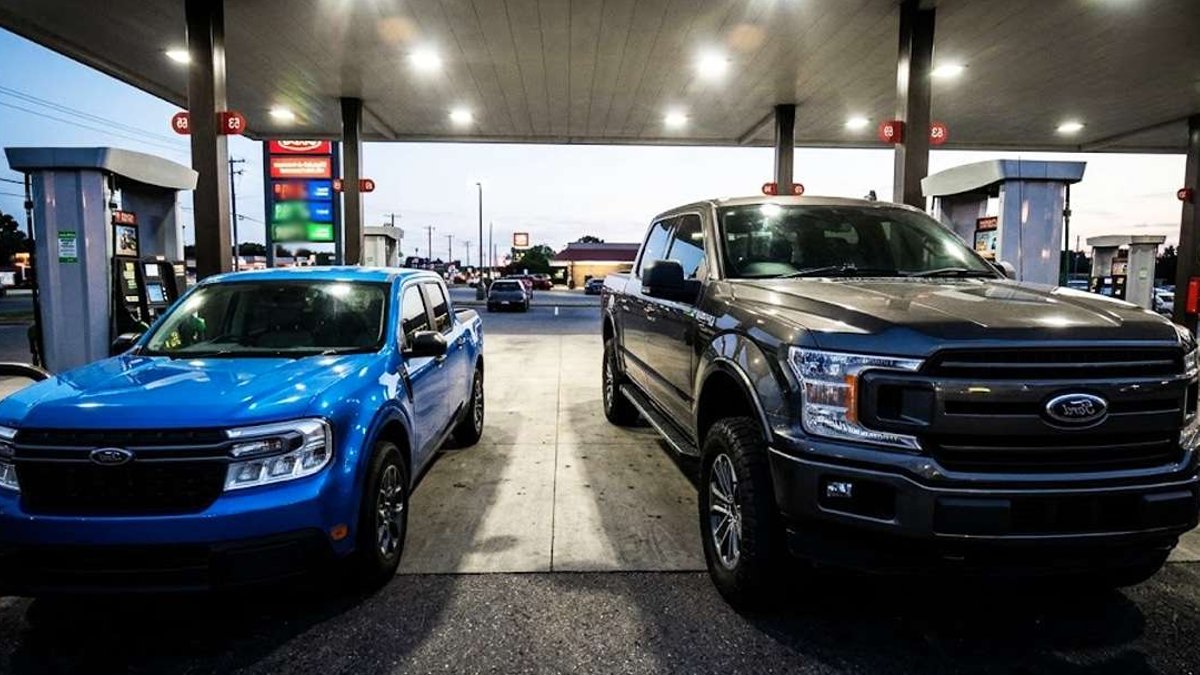
A Ford Maverick owner posted that his truck cost $14,000 less than the cheapest Ford F-150 and that it saved $3,750 in fuel over the first 27,000 miles, based on his own log.
He stressed that his figures came from his own fuel log rather than window-sticker estimates, mirroring a Maverick driver who logged 120,000 miles against a Slate EV to prove real-world efficiency.
Purchase price gap
The comparison uses the base price of the entry-level F-150, not a specific trim or a trade-in value. The Maverick’s lower sticker price creates a sizable upfront advantage for budget-focused buyers.
Actual savings shift with the trim levels compared, and the low-end market is moving fast, as shown by two sub-$30,000 electric trucks entering the segment.
In a Maverick Truck Club forum, the user wrote, “Y’all ever do the math between driving an F150 and Maverick? Plus it cost $14,000 less than the cheapest F150…”
The query was posted by rch75 in the Maverick Truck Club forum, where he asked other owners for direct input on the cost gap.
Fuel cost comparison
To verify the fuel savings, analysts applied the current AAA national average of $4.27 per gallon to the mileage logged.
EPA fuel economy data indicates the EcoBoost Maverick averages about 27 mpg. At the national price, that translates to roughly $3,116 in fuel, or 11.5 cents per mile.
A conventional F-150 achieving 18 mpg would cost about $4,251 for the same distance, creating a saving of roughly $2,135 versus the EcoBoost Maverick.
If the F-150’s fuel economy drops to 15 mpg, total fuel expense rises to around $4,532, widening the Maverick advantage to about $3,416.
The Maverick Hybrid, rated at higher efficiency, would reduce fuel cost to approximately $2,827, delivering savings of $3,289 against the 18-mpg F-150 and $4,570 against the 15-mpg model. This aligns closely with the owner’s reported $3,750 saving.
Combined, the $14,000 price advantage and the fuel savings total about $17,750, a gap that has ignited debates similar to the one where a Maverick owner called the $25,000 Slate ‘goofy’.
When compared with an electric truck such as the F-150 Lightning, the Maverick Hybrid’s 11.5 cents per mile is more than double the Lightning’s estimated 5 cents per mile using home charging.
Repair costs also affect total ownership. One Maverick owner cited a $902 claim for an AWD sensor, illustrating that non-fuel expenses can erode savings.
Towing and capability trade-offs
The Maverick’s towing capacity reaches 4,000 pounds with the optional tow package and 2,000 pounds without it, far below the payload of a fully equipped F-150.
For light loads, the front-wheel-drive Maverick proved capable of pulling a pontoon boat up a ramp without wheel spin, according to owner reports.
Long-distance towing presented challenges; a 250-mile tow was cancelled after the Maverick exhibited instability in crosswinds while hauling a camper.
Trailer stability tests comparing the Maverick to a Rivian R1T showed the larger truck maintained better control under identical conditions.


