
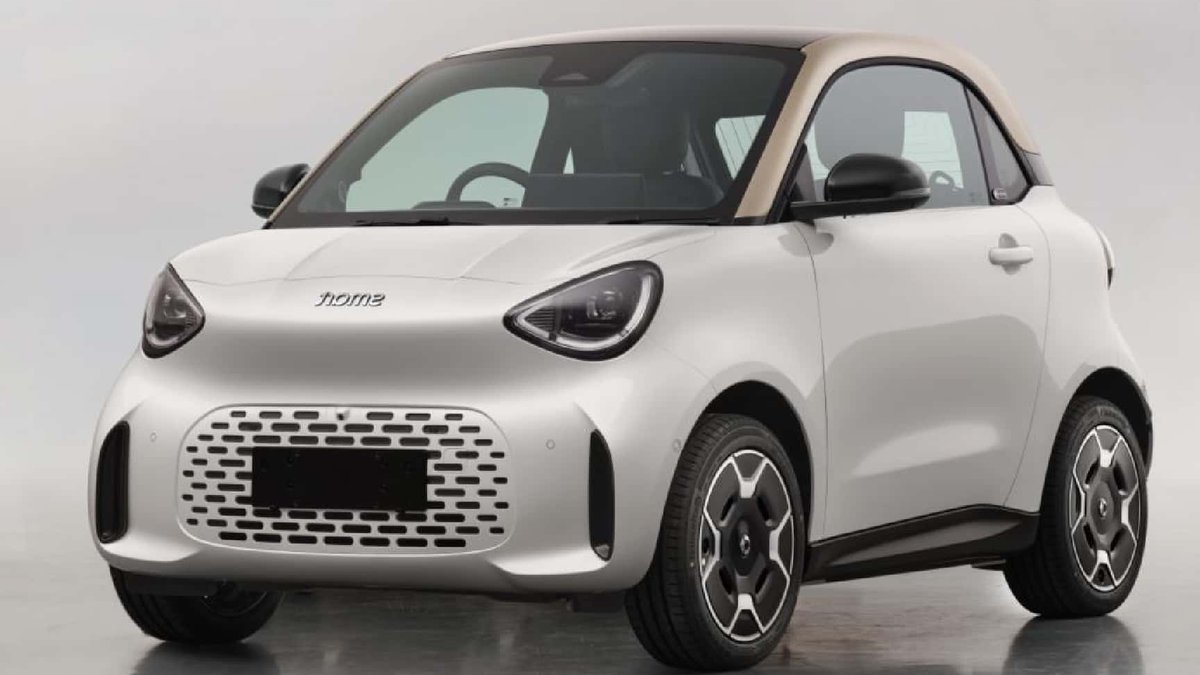
The original Smart car has returned as an all-electric vehicle.
The Smart #2 replaces the brand’s discontinued Fortwo with a modern electric model built for city driving. After three generations, production of the Fortwo ended in 2024. The automaker has now revived the concept with a battery-powered version set to launch later this year.
Design stays close to the concept
China’s Ministry of Industry and Information Technology recently published production approval documents for the Smart #2, confirming its final design. The car closely matches the concept shown in April, though the production version removes the concept’s cloth-like wheels and LED screens from the front bumper.
The front end adopts an aggressive look, following current automotive trends. While the concept suggested a futuristic style, the production model keeps the same shape but refines details for practical use.
Images from the filing show the car’s compact size, which aligns with Smart’s original approach. The #2 is slightly larger than the Fortwo but remains easy to maneuver in tight urban areas.
Battery and performance upgrades
The Chinese-market Smart #2 will use a rear-mounted 80-horsepower electric motor from Infimotion. Power comes from a lithium-iron-phosphate battery pack, with cells supplied by CATL and assembly handled by Geely, Smart’s co-owner alongside Mercedes-Benz.
The filing does not list the battery’s capacity, but the automaker previously stated the European version will have a 35.7-kilowatt-hour pack. That should provide an estimated range of about 186 miles—nearly triple the 58-mile EPA-rated range of the 2017 EQ Fortwo.
Related: BYD challenges Toyota with new mini car
Charging has also improved. The company says the #2 can reach 80% charge in under 20 minutes. The car will support vehicle-to-load functionality, letting owners use the battery to power external devices.
At 108.8 inches long, 65.7 inches wide, and 61.2 inches tall, the Smart #2 ranks among the smallest EVs available. Its wheelbase measures 73.8 inches, and the vehicle weighs 2,491 pounds. The top speed is limited to 87 mph, making it better suited for city streets than highways.
If the range and charging claims prove accurate, the model could work well for urban drivers who don’t need long-distance travel. The challenge will be convincing buyers to choose a two-seater in a market dominated by larger vehicles.
Production and pricing
The Smart #2 will debut at the Paris Motor Show in October, with production starting in China afterward. The brand may consider assembling the car in Europe if demand grows.
Pricing in Europe is expected to start below €22,500, positioning the Smart #2 as an affordable EV option. Whether it can compete with slightly larger electric hatchbacks remains uncertain.
For now, the automaker is focusing on cities where parking is limited and efficiency matters more than size. The new model aims to fill a gap in a segment where few competitors exist, offering a compact alternative for urban commuters.


