
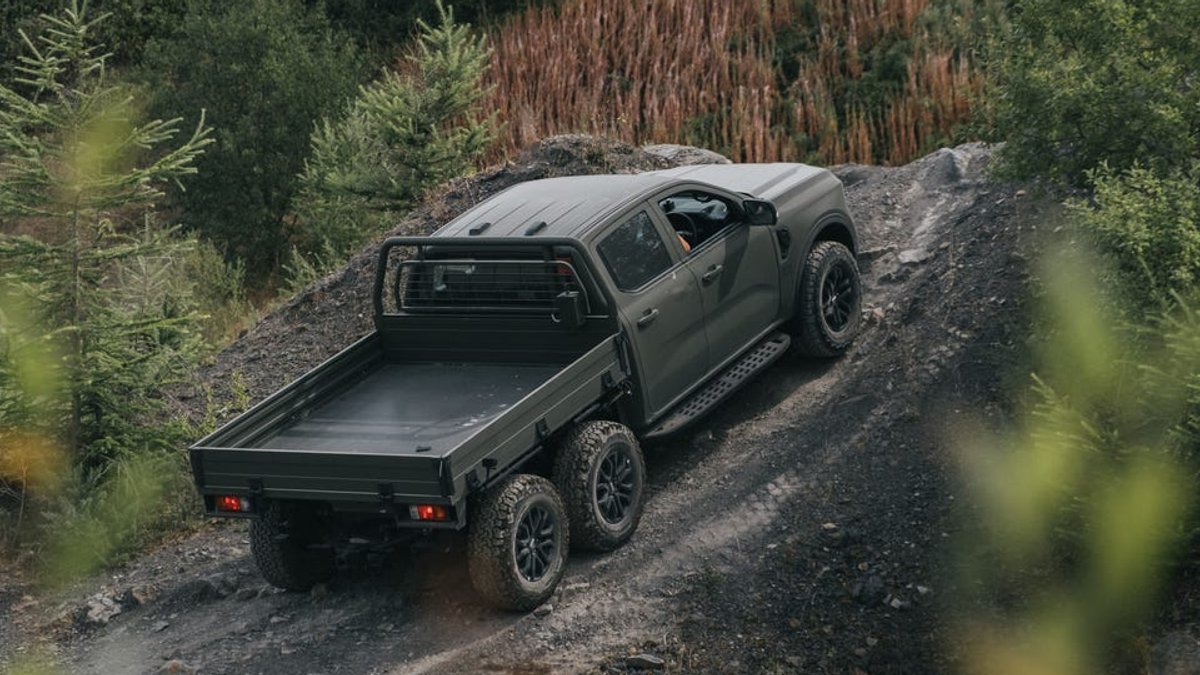
Ford is competing for the U.K. Ministry of Defence’s Light Mobility Vehicle Program by offering a range of modified Ford Rangers, including six-wheeled versions built specifically for military applications. These vehicles are based on the Ranger Super Duty platform, which is not sold in the United States, and would be customized by engineering firm Ricardo before being produced by General Trends Land Systems U.K. Should Ford secure the contract, the trucks would supplement the military’s existing fleet, which currently includes lighter tactical models and armored variants that resemble a Bronco.
The six-wheeled designs are particularly notable. One features a crew cab with a bed tray spanning two axles, while others include a troop carrier and an ambulance built on an extended-cab frame. Ford has not released detailed specifications, but the Super Duty’s baseline performance suggests it is built for heavy-duty use. The truck’s 3.0-liter diesel V-6 engine delivers 443 pound-feet of torque, and its 9,921-pound maximum towing capacity and 4,370-pound payload capacity already surpass those of standard U.S.-market Rangers. Adding a third axle would further enhance its load-bearing capabilities.
Ford’s focus on the Super Duty for this bid aligns with its broader global strategy. The Ranger is the company’s most global model, manufactured across five plants on four continents and sold in over 180 markets. This extensive production network could simplify logistical challenges for the U.K. military, reducing risks in parts supply and maintenance. Additionally, the truck’s diesel engine is produced in England, which supports local manufacturing priorities—a detail Ford emphasizes in its promotional materials.
The bid extends beyond raw power. Among the proposed vehicles are a light tactical model and an armored variant resembling a reinforced Bronco. The inclusion of troop carrier and ambulance versions demonstrates adaptability, addressing different operational needs. While Ford has not disclosed pricing or exact configurations, the Super Duty’s existing specifications suggest these trucks would perform exceptionally well in rugged terrain, where six wheels provide greater stability than four.
The U.S. military has its own approach to lightweight tactical trucks, with GM Defense supplying a modified Chevy Colorado ZR2 as the Infantry Squad Vehicle. This nine-passenger platform prioritizes mobility over payload capacity. In contrast, the U.K.’s program emphasizes heavier-duty applications, where the Ranger’s towing and payload capabilities could prove essential.
Ford’s decision to exclude the Super Duty from U.S. markets is strategic. The truck’s extreme towing and payload ratings would create direct competition with the F-150, which has a maximum towing capacity of 13,500 pounds but a payload limit of 2,440 pounds. U.S. Rangers, meanwhile, top out at 7,500 pounds towed and 1,767 pounds payload. By omitting the Super Duty from the American market, Ford avoids undermining sales of its flagship truck, even if it means foreign militaries gain access to a more capable vehicle.
If Ford wins the contract, the U.K. would receive a lineup of trucks designed for various roles, from transporting troops to medical evacuations, all built on a platform already proven in civilian use. The six-wheeled models would offer enhanced off-road performance and load capacity.


